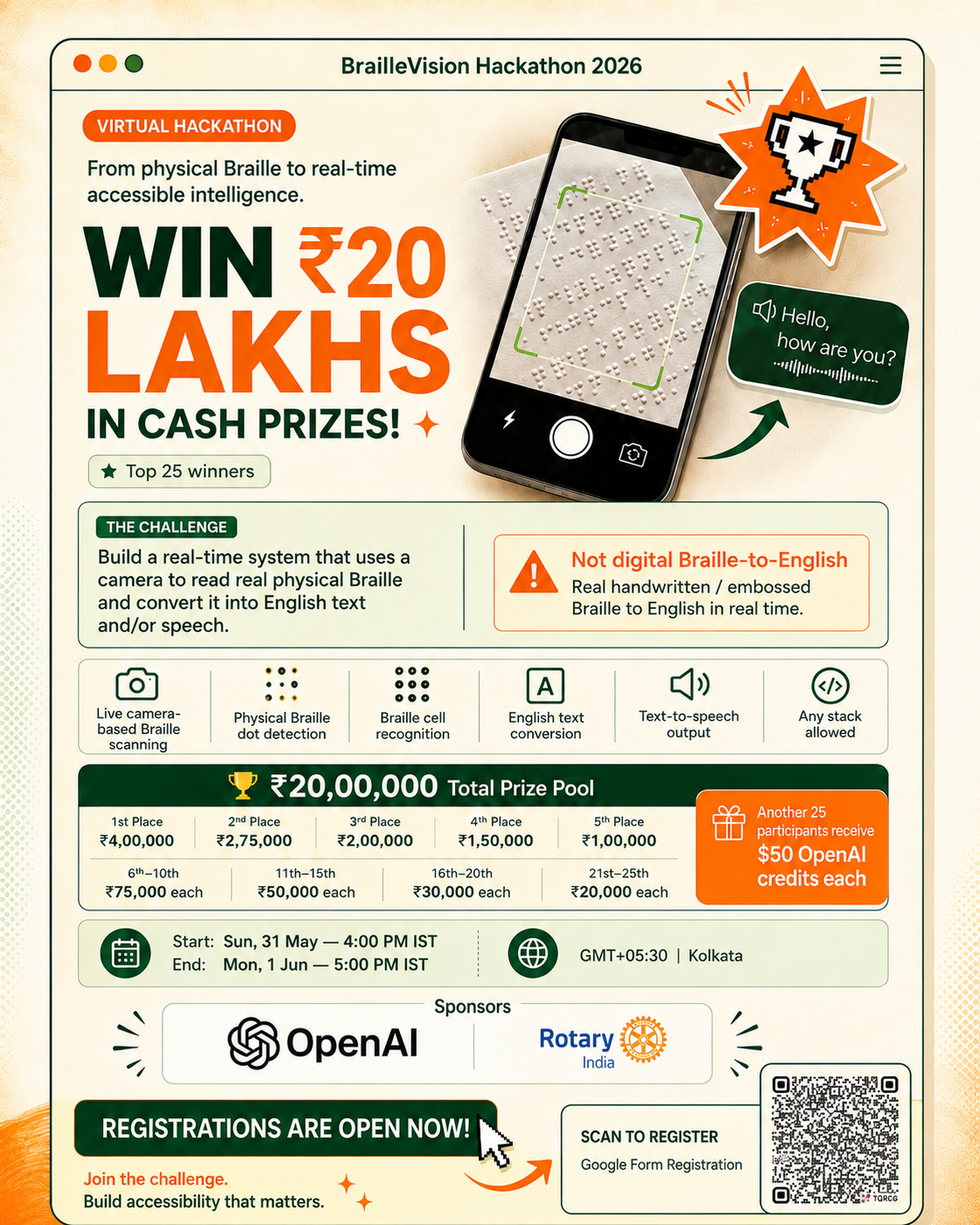
BrailleVision Hackathon 2026 is centered around one core problem: converting real physical Braille into English using camera-based technology.
Participants should think of this as a computer vision and accessibility challenge, not a simple text translation problem.
A typical system may follow this pipeline:
Camera Input
→ Image Preprocessing
→ Braille Dot Detection
→ Braille Cell Segmentation
→ Braille Pattern Recognition
→ English Text Conversion
→ Text-to-Speech Output
Participants may use any stack. Suggested tools include:
- Python
- OpenCV
- TensorFlow
- PyTorch
- MediaPipe
- Scikit-image
- NumPy
- Flask / FastAPI
- React
- Flutter
- Android Studio
- iOS / Swift
- Web camera APIs
- Google ML Kit
- Text-to-Speech libraries
- Edge AI or embedded systems
Suggested technical areas:
- Image processing
- Computer vision
- Object detection
- Dot detection
- Grid/cell segmentation
- Perspective correction
- Lighting normalization
- Real-time video processing
- Accessibility-focused UI/UX
- Speech output
Participants can explore ideas such as:
- A mobile app that scans Braille and reads it aloud
- A web app that uses a webcam to detect Braille in real time
- A Python/OpenCV system that detects raised dots using shadows and contrast
- An AI model trained to identify Braille cell patterns
- A low-vision friendly interface with voice instructions
- A classroom tool for teachers who need to understand Braille worksheets
- A caregiver tool that helps read physical Braille notes
- A scanning assistant that guides the user to adjust camera distance and lighting
The most impactful solutions will combine technical accuracy with real accessibility thinking.