Important Message from Devpost Support
Please note that the organizer was found to be in violation of our Terms of Service, and as a result the listing of this hackathon is no longer live.
We know this is a frustrating situation, especially if you invested real time and effort into your submission. While Devpost hosts hackathons on our platform, we don't run all of them, so we're not able to help with questions about prizes, judging, or other commitments the organizer made.
The good news: your project is yours, and it stays on your Devpost profile. You can submit it to other eligible hackathons anytime. Browse open hackathons here.
Thanks for being part of the Devpost community.
****About the Challenge
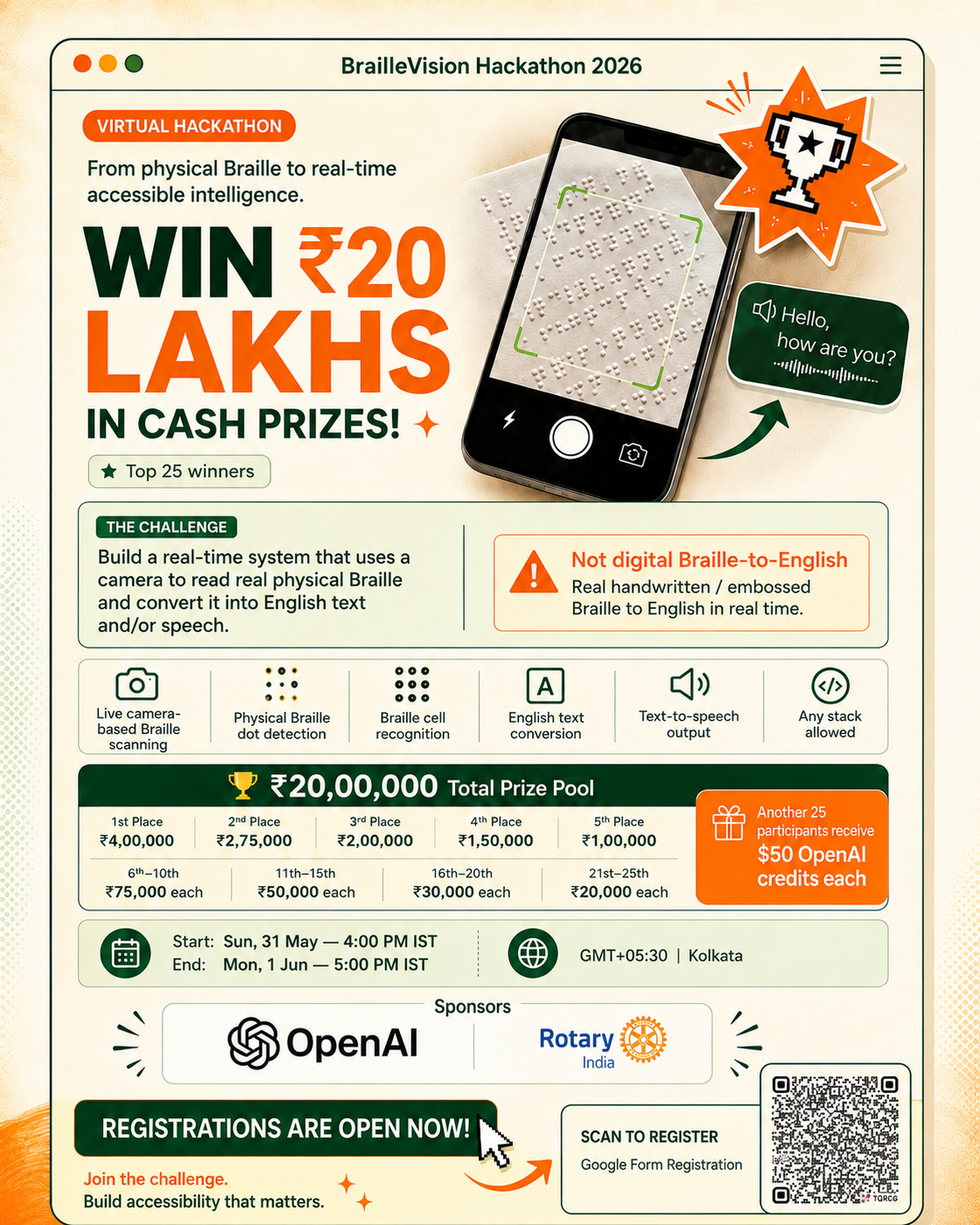
BrailleVision Hackathon 2026 is a virtual hackathon focused on building real-world assistive technology for visually impaired users.
The challenge is to build a system that can use a camera to scan real physical Braille and convert it into English text and/or speech in real time or near real time.
This is not a simple digital Braille translator. Participants should not only convert Unicode Braille symbols like ⠓⠑⠇⠇⠕ into English. The goal is to process real camera input of physical handwritten or embossed Braille dots from paper.
Participants may use any technology stack, including Python, OpenCV, TensorFlow, PyTorch, Flutter, Android, React, web camera APIs, mobile apps, or embedded systems.
Why This MattersBraille is an essential reading and writing system for many visually impaired users. However, reading physical Braille requires touch-based literacy, and many caregivers, teachers, volunteers, and accessibility workers may not be able to understand Braille quickly.
This hackathon encourages participants to build technology that can bridge this gap by converting real Braille into readable English and spoken output.
Prize PoolTotal Cash Prize Pool: ₹20,00,000
Top 25 winners will receive cash prizes.
Prize Distribution:
1st Place — ₹4,00,000
2nd Place — ₹2,75,000
3rd Place — ₹2,00,000
4th Place — ₹1,50,000
5th Place — ₹1,00,000
6th–10th Place — ₹75,000 each
11th–15th Place — ₹50,000 each
16th–20th Place — ₹30,000 each
21st–25th Place — ₹20,000 each
Another 25 selected participants will receive $50 OpenAI credits each.
Get StartedYour solution should focus on detecting real Braille dots from camera images or video, grouping them into Braille cells, recognizing the dot pattern, and converting the result into English text and/or voice output.
The strongest projects will focus not only on recognition accuracy but also on usability for visually impaired users.
Requirements
Build a working prototype that can:
- Capture real physical Braille using a camera, webcam, or mobile camera
- Detect physical handwritten or embossed Braille dots
- Segment dots into Braille cells
- Convert recognized Braille cells into English text
- Provide real-time or near real-time output
- Include text-to-speech output, if possible
- Support accessibility-focused interaction such as voice guidance, high contrast UI, large buttons, or camera alignment feedback
Participants may build:
- Mobile app
- Web app
- Desktop app
- Python/OpenCV prototype
- AI/ML-based recognition system
- Embedded or edge AI prototype
- Hybrid software solution
Each team must submit:
- Working demo video
- GitHub repository or source code link
- Short project explanation
- Technology stack used
- Instructions to run the project
- Explanation of how the system detects physical Braille
- Accuracy or performance notes, if available
- Future improvement plan
Optional but recommended:
- Live demo link
- Screenshots
- Dataset or sample images used
- Model training details, if using ML/DL
- Accessibility features explanation
Prizes
BrailleVision Hackathon 2026 — Top 25 Cash Prizes
Devpost Achievements
Submitting to this hackathon could earn you:
Judges

JoelDeva

roshan
Judging Criteria
-
Physical Braille Recognition Accuracy
How accurately the project detects real physical handwritten or embossed Braille dots from camera images or video and converts them into correct English text.
Questions? Email the hackathon manager
Tell your friends
This site is protected by reCAPTCHA and the Google Privacy Policy and Terms of Service apply.